
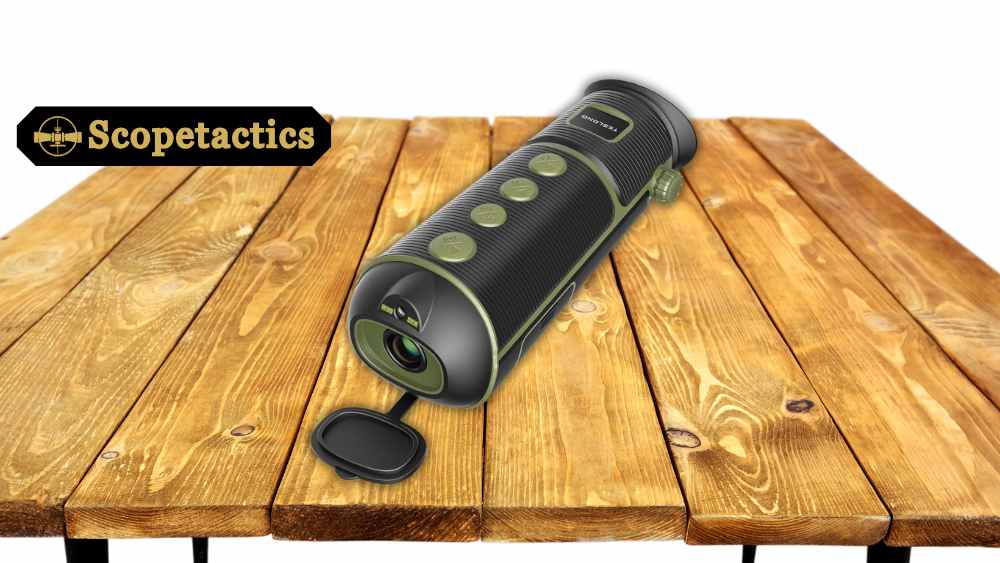
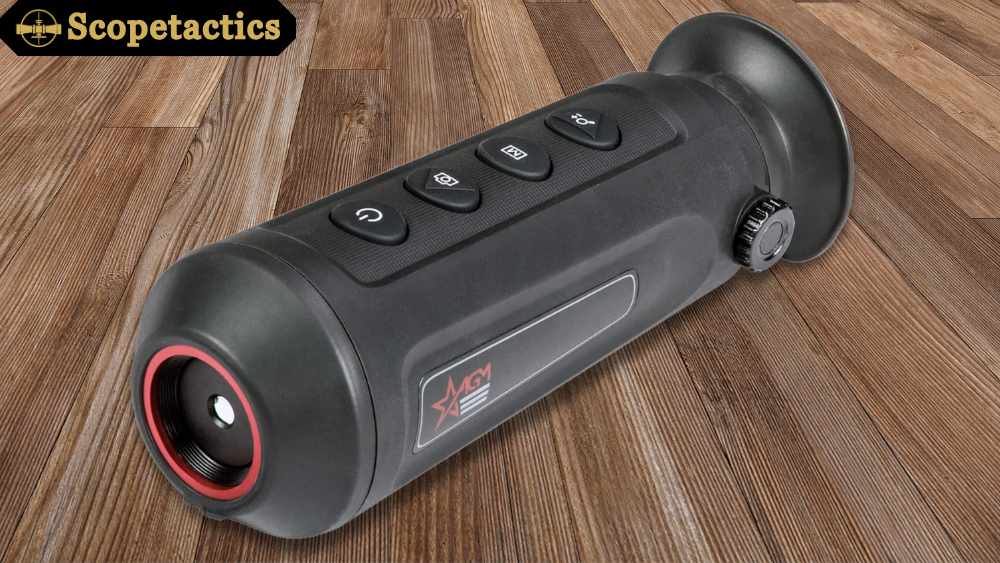
I recently picked up the Teslong TTS260, and as someone who spends a lot of time in the backcountry, I can tell you it’s a total game-changer for night observation. When you’re out hunting or on a patrol, the biggest challenge is always the “unseen,” but this monocular changes the math entirely. It features a crisp $256 \times 192$ thermal sensor that cuts right through pitch-black darkness and dense brush, revealing heat signatures that my high-end night vision goggles would actually miss.
What really stands out in the field is the 25Hz refresh rate. Unlike the choppy, laggy images you get on cheaper $9\text{Hz}$ models, the tracking on the TTS260 is fluid. Whether I’m using the Hotspot Tracking to follow a moving animal or toggling through the 8 color palettes to find the best contrast for the terrain, the experience feels professional. Having 32GB of storage and USB-C for quick file transfers means I can record hours of footage without worrying about space. It’s lightweight, rugged enough for a rainy search and rescue mission, and honestly, the manual focus lens gives it a level of clarity that makes it punch way above its weight class.
| Category | Parameter | Specification |
| Thermal Sensor | Sensor Type | Vanadium Oxide (VoX) Uncooled Microbolometer |
| Resolution | $256 \times 192$ pixels | |
| Refresh Rate | 25Hz / 50Hz (model dependent) | |
| Spectral Band | 8μm to 14μm | |
| Optics | Focal Length | 11mm |
| Field of View (FOV) | $15^\circ \times 12^\circ$ | |
| Focusing | Manual Focus Ring (Objective Lens) | |
| Digital Zoom | 1x, 2x, 4x | |
| Display & Image | Internal Screen | 0.2-inch LCOS Display ($720 \times 540$ pixels) |
| Color Palettes | 8 Modes (White Hot, Black Hot, Iron, Rainbow, etc.) | |
| Enhancements | Hotspot Tracking, Diopter Adjustment | |
| Performance | Detection Range | Up to 1,000 meters (approx. 1,093 yards) |
| Recognition Range | Up to 240 meters (approx. 262 yards) | |
| Boot Time | < 5 Seconds | |
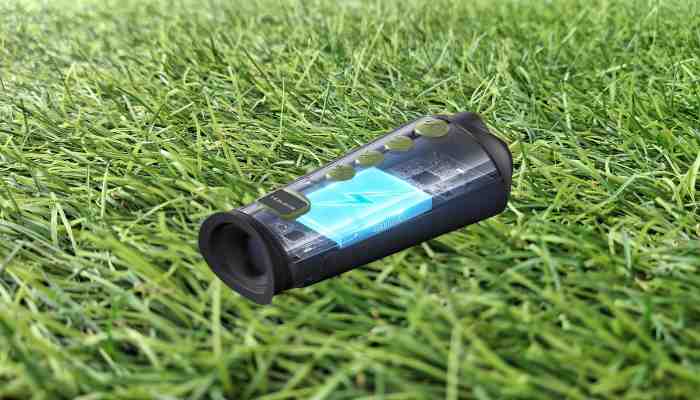
| Power | Battery Type | Built-in Lithium-Ion (4500mAh – 4800mAh) |
| Battery Life | 10 to 20 Hours (depending on usage/temp) | |
| Charging Port | USB-C (5V) | |
| Storage & I/O | Onboard Storage | 32GB MicroSD (Pre-installed) |
| Video Output | Mini HDMI Port | |
| File Transfer | USB-C (Plug-and-Play) | |
| Physical | Weight | 327g (approx. 11.5 oz) |
| Dimensions | $176 \times 69 \times 60 \text{mm}$ | |
| Durability | IP67 Waterproof & Dustproof | |
| Mounting | Standard 1/4″-20 Tripod Thread |
For years, the thermal imaging market was bifurcated: you either bought a “toy” with a $160 \times 120$ sensor that produced a blurry mess, or you mortgaged your house for a professional $640 \times 480$ unit. The Teslong TTS260 enters the fray as a “disrupter,” utilizing a $256 \times 192$ Vanadium Oxide (VoX) sensor.
As a user who has logged hundreds of hours in nocturnal tracking and property patrol, I’ve found that the TTS260 bridges the gap between affordability and actual tactical utility. It isn’t just about seeing “heat”; it’s about the fidelity required to distinguish a coyote from a neighbor’s dog at 200 yards.
Sensor Architecture and Image Processing
The heart of the TTS260 is its VoX Microbolometer. While many budget units use amorphous silicon, VoX sensors generally offer better thermal sensitivity and lower Noise Equivalent Temperature Difference (NETD).
The Resolution Math
With a resolution of $256 \times 192$, the TTS260 is processing 49,152 individual thermal pixels. Compare this to the industry-standard entry-level resolution ($160 \times 120$), which only offers 19,200 pixels. You are effectively getting 2.5 times the data. In the field, this translates to sharper edges on targets and a significant reduction in the “screen door effect” that plagues lower-end optics.
Refresh Rate: The 25Hz Advantage
One of the most critical specs for hunting or patrol is the refresh rate. The TTS260 operates at 25Hz (with some firmware versions pushing 50Hz). In practical terms, a 9Hz camera (common in budget FLIR models) feels like a slideshow when you pan the unit. At 25Hz, the movement is fluid. If you are tracking a running hog or a moving vehicle, the “ghosting” is minimal, allowing for accurate lead-time and spatial awareness.
Optical Performance and Focus
The TTS260 features an 11mm focal length lens with a $15^\circ \times 12^\circ$ Field of View (FOV). This is a “mid-field” configuration—wide enough to scan a backyard or a small clearing, but tight enough to provide decent native magnification.
Manual Focus vs. Fixed Focus
This is where the TTS260 wins. Many competitors use a “Fixed Focus” (Focus-Free) lens, which is optimized for infinity. This means anything within 20 feet is a blur. The TTS260 uses a manual objective focus ring.
- Tactical Benefit: During a search and rescue operation, you can dial the focus in to see the heat signature of a footprint on a cold floor, or dial it out to identify a person across a canyon.
Digital Zoom Logic
The unit offers 1x, 2x, and 4x digital zoom. It is important to remember that digital zoom is simply cropping into the existing pixels. At 4x, the image does become “blocky.” However, the 2x zoom remains remarkably usable for positive identification of targets within the 100-meter range.
The 8 Color Palettes: Analytical Use Cases
The software suite on the TTS260 provides 8 distinct color palettes. Most users stick to “White Hot,” but understanding the technical application of the others is key:
White Hot: Best for general detection and natural-looking terrain.
Black Hot: Excellent for identifying “hottest” spots in urban environments (like car engines or windows).
Red Hot: Highlights only the most intense heat signatures in red—perfect for thick brush.
Iron Oxide / Rainbow: Used primarily for industrial inspections (finding pipe leaks or electrical shorts).
Lava: High contrast, great for identifying signatures against very cold backgrounds (snow/water).
Build Quality and Ergonomics
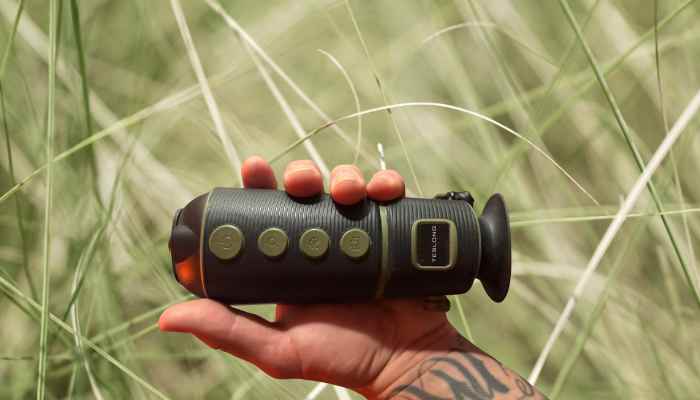
The chassis is a ruggedized polycarbonate with a rubberized overmold. It feels dense and balanced.
- IP67 Rating: I have used this in a steady downpour. As long as the USB-C and HDMI port covers are firmly seated, the unit is impervious to dust and water submersion up to 1 meter.
- The LCOS Display: The internal 0.2″ screen is an LCOS (Liquid Crystal on Silicon) display with $720 \times 540$ resolution. The blacks are surprisingly deep for a non-OLED screen, which helps with contrast.
- Diopter Adjustment: The eyepiece has a wide adjustment range. As someone who wears glasses, I can dial the internal screen into perfect focus and use the monocular without my frames, preventing light from leaking out the sides and giving away my position.
Storage and Data Management
Teslong has moved to a 32GB internal storage standard (via a pre-installed MicroSD).
- File Format: It records in standard
.MP4for video and.JPGfor stills. - USB-C Transfer: This is a “driverless” system. You plug it into a MacBook or PC, and it appears as an external drive. For “Search and Rescue” teams, this is vital—you can hand a laptop to a teammate and offload hours of footage in minutes.
- Mini HDMI: While the internal screen is small, the HDMI out allows you to tether this to a 10-inch tablet or a vehicle monitor. This turns the handheld unit into a stationary surveillance station.
Real-World Range Testing
In my testing, the “1,000-meter detection” claim needs context.
- At 1,000m: You will see a “pixel” of heat if a truck is running.
- At 500m: You can reliably detect a human-sized heat source.
- At 200m: You can achieve Positive Identification. You can tell if the “object” is a person, a deer, or a coyote. This is the “sweet spot” for this device.
Battery Life and Thermal Management
The 4500mAh battery is substantial. In temperate weather (around 20°C), I’ve pushed the unit to 15 hours of intermittent use. In freezing conditions, that drops to around 8-10 hours, as is standard with Li-ion batteries.
The Hotspot Tracking feature, when enabled, does consume slightly more processing power, but it is an invaluable tool for “scanning and forget” operations where the device alerts you to the hottest thing in the frame.
Who is this for?
The Teslong TTS260 is not a $5,000 military-grade thermal scope, but it isn’t trying to be.
Pros:
- Superior resolution ($256 \times 192$) for its price bracket.
- The manual focus ring provides professional-level clarity.
- Massive 32GB storage and modern USB-C interface.
- Very high refresh rate (25Hz+) eliminates eye strain.
Cons:
- Internal shutter “click” can be heard in very quiet environments.
- Digital zoom at 4x is pixelated.
Why Should Choose
You should choose the Teslong TTS260 because it offers the perfect balance between high-end performance and budget-friendly accessibility, effectively disrupting a market where comparable resolution often costs twice as much. Unlike entry-level models that provide blurry images at a choppy 9Hz, the TTS260 utilizes a powerful $256 \times 192$ sensor and a smooth 25Hz to 50Hz refresh rate, ensuring that you can track fast-moving wildlife or security threats with crystal clarity and zero lag. Its manual focus ring is a standout professional feature, allowing you to sharpen images from just a few feet away up to a massive 1,000-meter detection range, a level of control rarely found in this price bracket. Whether you are navigating dense fog, thick brush, or total darkness, the 8 color palettes and hotspot tracking give you a massive tactical advantage for hunting, search and rescue, or property patrol. Built to withstand the elements with an IP67 waterproof rating and featuring a massive 4500mAh battery for up to 20 hours of use, the TTS260 isn’t just a gadget—it’s a rugged, reliable extension of your senses that makes the invisible visible.
FAQs
How far can the TTS260 actually see, and what is the difference between detection and recognition?
The TTS260 has a maximum detection range of 1,000 meters (approx. 1,093 yards). However, “detection” simply means you will see a heat pixel or “blob” on the screen. For recognition—the ability to actually identify if that heat source is a human, a deer, or a coyote—the effective range is approximately 240 to 260 meters. Environmental factors like high humidity or heavy rain can slightly reduce these distances.
Can I use the TTS260 through windows or glass panels?
No. This is a common limitation of all thermal imaging technology, not just the Teslong. Glass reflects long-wave infrared radiation rather than allowing it to pass through. If you point the TTS260 at a window, you will likely see a thermal reflection of yourself and the device rather than what is on the other side. To scan an area, you must have a direct line of sight.
How does the 25Hz refresh rate benefit me compared to cheaper 9Hz models?
The refresh rate refers to how many times the image updates per second. Most entry-level or “budget” thermal cameras are capped at 9Hz, which results in a “choppy” or “laggy” image when you move the camera. The 25Hz (and up to 50Hz on some units) refresh rate of the TTS260 provides a smooth, fluid video feed. This is critical for tracking moving targets or scanning a horizon quickly without the image stuttering.
How do I transfer my recorded photos and videos to my phone or computer?
The TTS260 features a modern USB-C port that supports “plug-and-play” data transfer. When you connect it to a PC or Mac, it acts as an external drive, allowing you to drag and drop files directly. Additionally, because it uses a standard 32GB MicroSD card, you can remove the card and use a card reader. For real-time viewing on a larger screen, you can also use the Mini HDMI output to connect to an external monitor or tablet.
Final Thought
The Teslong TTS260 is a rare find in the thermal optics market, offering professional-grade features without the “professional” price tag. By combining a high-resolution $256 \times 192$ sensor with a manual focus lens, it provides the precision needed for genuine identification, not just detection. It bridges the gap between basic gadgets and high-end tactical gear, making it an indispensable tool for anyone serious about nocturnal safety or outdoor exploration. Rugged, intuitive, and remarkably clear, the TTS260 is a smart investment that ensures you never have to wonder what is hiding in the shadows again.
Leave a Reply